Voice Profile

AI scripts that actually sound like you, not like a generic AI writer.

The most common failure mode of single-shot AI writers is sounding like AI. Voice profile is Melda's answer: a captured signature of how you actually talk, applied as conditioning context so every script reads as spoken proof in your voice.

Your voice
Captured

Voice profile extracts how you actually talk and write from your own source content — tone, vocabulary, teaching style, signature phrases.

No flattening
Output quality

Generated scripts read as spoken proof in your voice instead of the homogeneous register most AI writers default to.

Yours alone
Privacy

Your content is encrypted in transit and at rest. Voice profile is used only to generate your own scripts. We never train shared AI models on your data.

What it captures

The four markers that make a voice yours.

Voice profile is not a personality slider. It is a captured signature of how you actually write and speak, extracted from your own source content — so the patterns that show up in your real work show up in the generated script.

Tone

How direct, warm, calm, or urgent the writing is — captured from how you write and speak in real source material.

Vocabulary

The specific words and phrases that show up consistently across your content. Generic AI tools homogenize this; voice profile preserves it.

Teaching style

How you set up a contrast, frame a problem, or lead someone through a move. Voice profile captures the structural pattern, not just the surface.

Signature phrases

The reusable lines that have become part of your voice — the way you open, the way you punctuate a payoff, the way you close.

Why generic AI writing fails creators

Generic AI writers homogenize the markers that make you you.

The output ends up sounding like every other AI-written post — pleasant, fluent, and indistinguishable. Creators feel it before audiences do, and it is the single biggest reason creators stop using AI tools after the first month.

Generic AI failure modes

  • Vocabulary collapses to a generic register that sounds like a competent stranger.
  • Signature phrases disappear because the model averaged them away.
  • Argument structure flattens into bullet-style explanation rather than spoken proof.
  • Tone overshoots into either too-formal or too-hyped because the model has no source signal.
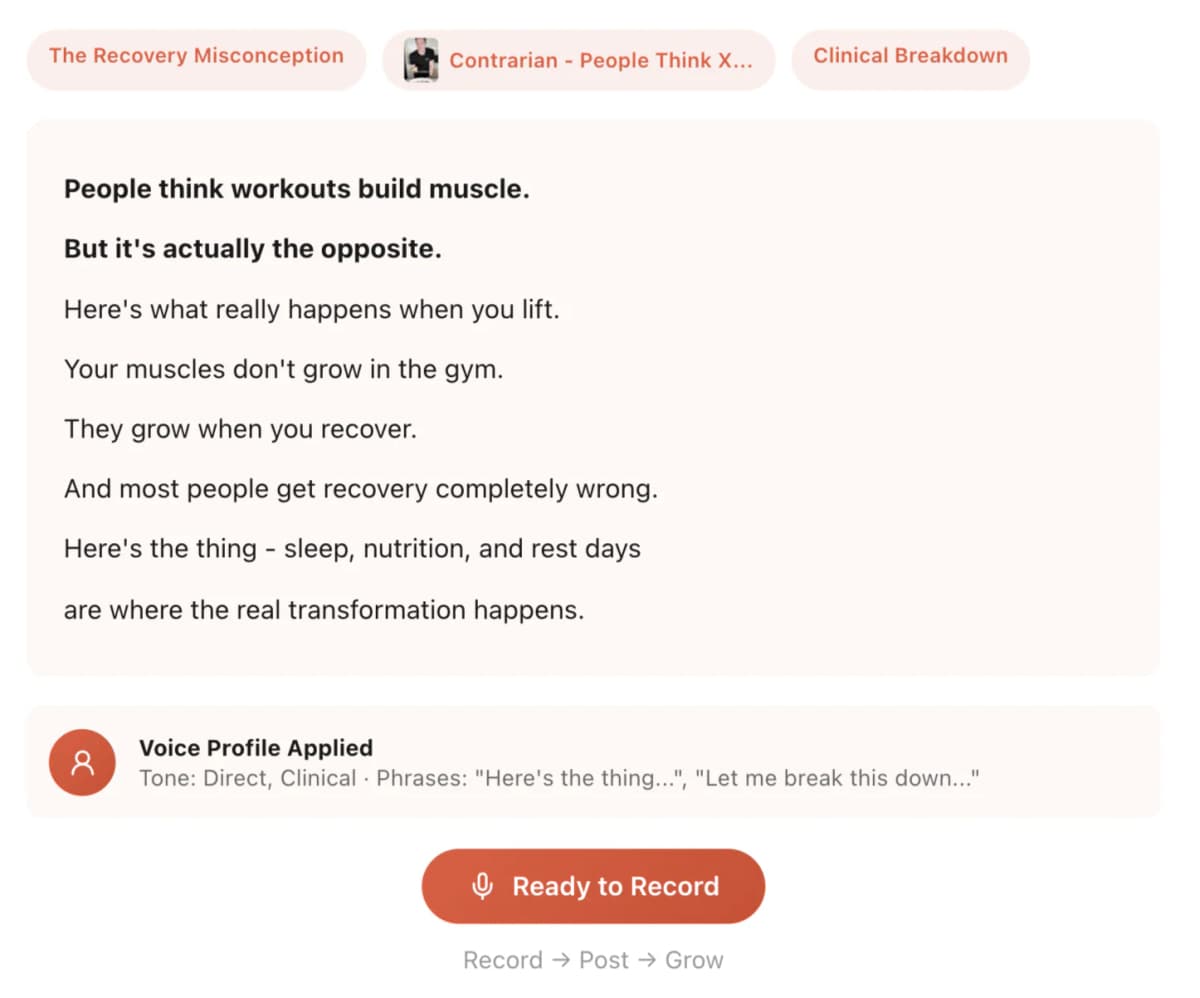
Melda script generation with voice profile applied

How it works

Voice profile is conditioning context, not a wrapper around the prompt.

Most tools claim to preserve voice by tacking on a style instruction. Melda treats voice profile as live conditioning — the markers extracted from your source content shape every stage of script generation, not just the final polish.

1. Captured

Melda extracts voice markers from your own creator-original source content — your podcasts, talking-head videos, transcripts.

2. Applied

Voice profile threads through every stage of script generation — planning, drafting, revision — so the markers do not get lost between steps.

3. Yours alone

Voice profile is private to your account. It is never used to train shared AI models or shared with third parties.

FAQ

Common questions, answered directly.

These answers match the structured data on this page so search engines and answer engines see the same claims that visitors can read.

What is a voice profile?

A voice profile is a captured signature of how you actually talk and write — your tone, vocabulary, teaching style, signature phrases, and argument structure — extracted from your own content. Melda uses it to keep generated scripts close to your real speaking voice instead of a generic AI default.

Why do AI scripts usually sound like AI?

Generic AI writers generate from a blank prompt and a generic style. The output flattens distinctive voice markers — rhythm, signature phrases, the way you set up a contrast — into a homogeneous register. Melda is built around your voice profile and your real source material so the script reads as spoken proof in your voice instead of generic copy.

How does Melda capture my voice?

Voice profile analyzes your own source content — podcasts, transcripts, talking-head videos — to extract the teaching style, vocabulary, and argument structure that show up consistently. The profile becomes conditioning context for every generated script so the output sounds like you, not like a generic AI writer.

Will my voice profile be used to train shared AI models?

No. Your content is encrypted in transit and at rest, and your voice profile is used only to generate your own scripts. We never share your data with third parties or use it to train shared AI models.