Melda

Example workflow

Turn coaching calls into short-form scripts without making up proof.

Coaching calls are full of usable content, but the valuable moments are usually buried inside messy conversation. This workflow shows how to turn the source into recordable scripts, then review each draft and remove private details before publishing.

About 3 scripts free · no card required

Call
Source

Start from a real coaching call transcript, client question, or workshop notes.

Moment
Extraction

Find the repeated objection, reframe, diagnostic, framework, or teachable moment.

Script
Output

Turn the strongest moment into a recordable short-form script, then review it to remove private client details.

Workflow

Example workflow, not a fabricated case study.

Use this sequence when the source is a real call or transcript, but the public output needs to become a clean teaching asset.

  1. Step 1

    Bring the call transcript

    Paste or upload the call transcript (Zoom, Meet and most podcast hosts export one) so the content starts from real audience language.

  2. Step 2

    Extract the repeated question

    Look for the moment where a client asks the thing other prospects are probably thinking too.

  3. Step 3

    Add the coach take

    Anchor the script in your diagnosis, reframe, or teaching point so the output sounds like your expertise.

  4. Step 4

    Match the hook pattern

    Use a hook that fits the moment: tension, contradiction, consequence, or a useful identity shift.

  5. Step 5

    Generate and review the script

    Turn the moment into a draft you can record, then remove any private or identifying client context before publishing.

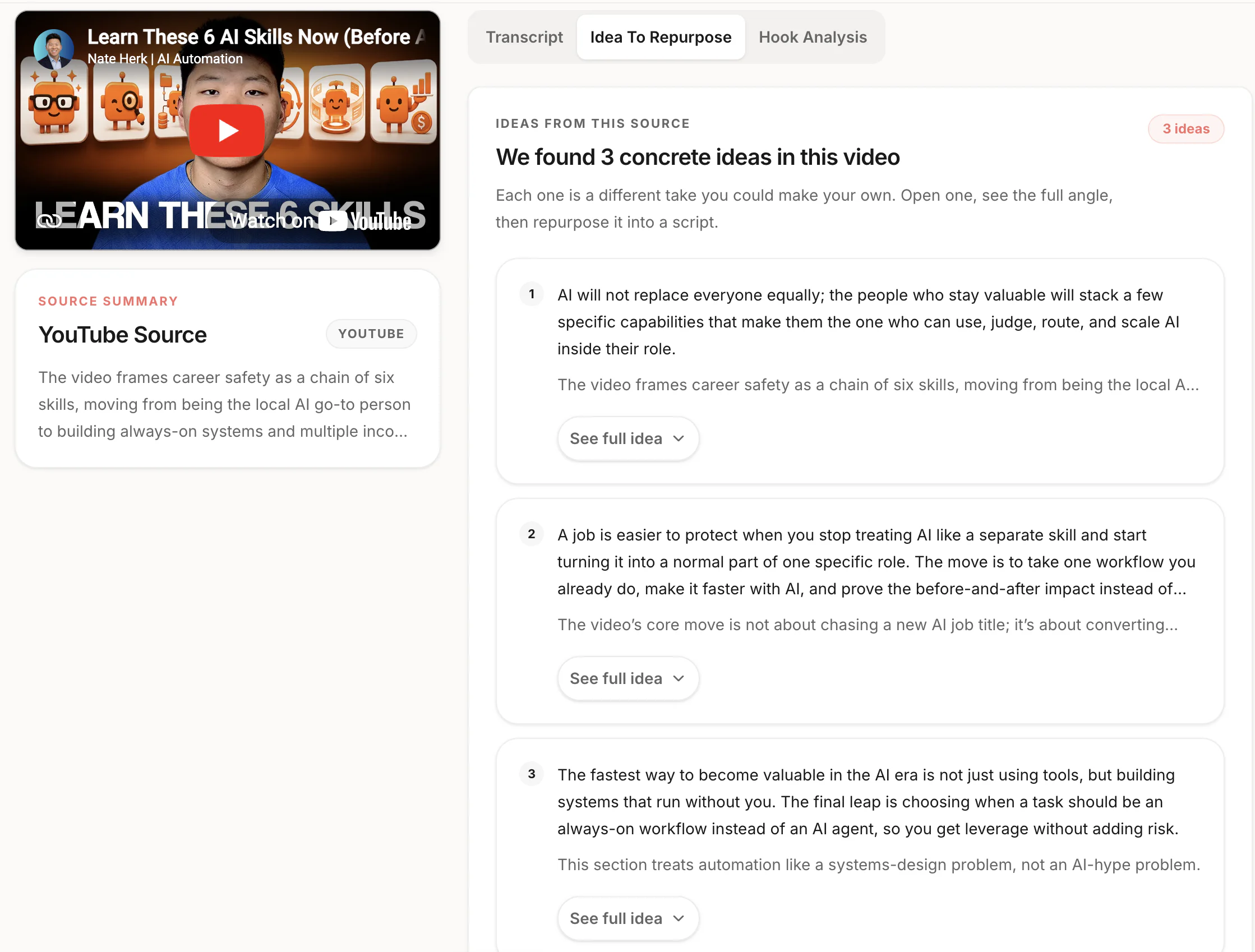
Melda source analysis screen showing extracted ideas from source material

Worked example

One coaching call, traced to a script.

These passages quote Preston Chin, Melda's cofounder, from his coaching call. The client's words are omitted. The script below is Melda's unedited output; the beat labels are ours.

From the call

…I've dealt with very critical bosses in my career. And I can tell you that the number one way to handle a proposal that way is to disarm them.
…I'm going to acknowledge upfront that there are some risks to the plan … before we figure out an implementation plan together, if it even makes sense.

The reusable lesson: acknowledge a skeptical stakeholder's concerns before discussing the upside of a proposal. The source supports that move without revealing the client's identity or turning the whole call into a public post.

The script

  1. Hook

    Most presenters believe a proposal should lead with its biggest benefit, but with a skeptical stakeholder that order is exactly what triggers the resistance.

  2. Point

    A critical boss is already weighing what could go wrong. If you jump straight to the upside, they may never hear the proposal.

  3. Proof

    I’ve dealt with very critical bosses in my career, and that’s where this approach comes from. Disarm them first.

  4. Move

    Acknowledge the risks you know they’re considering, and make sure you’re on the same page before discussing the upside. Then you can figure out an implementation plan together, if it even makes sense.

  5. Close

    Before your next proposal, name one real risk upfront and invite your boss into the conversation.

Review before publishing

Separate quoted evidence from the writer's framing.

The opening, explanation, and close frame the lesson. These four source-to-script pairs show exactly where the call supplies the wording or move. Review both kinds of sentence before recording.

  1. Source → script

    I've dealt with very critical bosses in my career

    I’ve dealt with very critical bosses in my career, and that’s where this approach comes from.

  2. Source → script

    the number one way to handle a proposal that way is to disarm them

    Disarm them first.

  3. Source → script

    acknowledge upfront that there are some risks to the plan

    Acknowledge the risks you know they’re considering, and make sure you’re on the same page before discussing the upside.

  4. Source → script

    figure out an implementation plan together, if it even makes sense

    Then you can figure out an implementation plan together, if it even makes sense.

Before sharing your own version, check permission to use the material, remove private client details, and confirm the hook promises only what your source supports.

What to mine

The best coaching content usually starts as a repeated moment.

Do not publish the private call. Extract the reusable lesson behind the moment.

A client objection that keeps repeating
A reframe that changes how someone sees the problem
A simple diagnostic question
A framework that organizes a messy topic
A story moment that proves the lesson

Coach path

Build from call evidence, then record in your own voice.

Melda is built for coaches who want their content to stay close to the actual questions, objections, and teaching moments inside their work.

FAQ

Questions creators actually ask

Straight answers to the questions creators ask before they start.

Can coaching calls become short-form content?

Yes. Coaching calls often contain repeated questions, objections, reframes, diagnostics, frameworks, and story moments that can become short-form scripts when the private details are removed and the reusable lesson is kept.

What should I extract from a coaching call?

Extract the repeated moment behind the call: the client objection, the useful reframe, the diagnostic question, the simple framework, or the story moment that proves a lesson. The goal is one bounded idea with enough proof to stand alone.

Does Melda publish private client details?

No. Melda helps turn source material into scripts, but creators should review every draft and remove private or identifying client context before publishing. The public asset should teach the reusable lesson, not expose the private call.

How many scripts can one coaching call produce?

It depends on the number of distinct moments in the call. A useful call may contain several separate questions, objections, or teaching moments, but each short-form script should focus on one clear idea rather than trying to cover the whole conversation.

Ready to try it on your own material?

About 3 scripts free · no card required