Melda

Example workflow

Turn podcast episodes into Shorts by mining the moments, not summarizing the show.

A strong short-form script does not try to compress the whole episode. It pulls one moment with a clear hook, proof, and payoff, then shapes it for the viewer who has never heard the full conversation.

About 3 scripts free · no card required

Episode
Source

Start with the full episode or transcript so the short-form output stays tied to the real conversation.

Moments
Selection

Find story pivots, strong quotes, frameworks, contrarian lines, and tactical lessons.

Shorts
Output

Turn the strongest moments into YouTube Shorts, TikTok, and Reels scripts without flattening the episode into a summary.

Workflow

Do not clip the whole episode. Mine the moments.

Use this sequence to turn one episode into discrete short-form scripts with their own reason to exist.

  1. Step 1

    Paste the episode’s YouTube link or upload its transcript

    Start with the full source so the script is built from what was actually said, not a topic guess.

  2. Step 2

    Break the conversation into moments

    Find the moments that can stand alone: one claim, one story turn, one framework, or one useful quote.

  3. Step 3

    Choose the strongest moment

    Pick the moment with enough proof and tension to become a short-form script on its own.

  4. Step 4

    Match a hook to the moment

    Use a hook pattern that makes the listener want the next sentence without misrepresenting the source.

  5. Step 5

    Generate platform-ready scripts

    Create a short-form script that can work across YouTube Shorts, TikTok, and Reels after platform-specific editing.

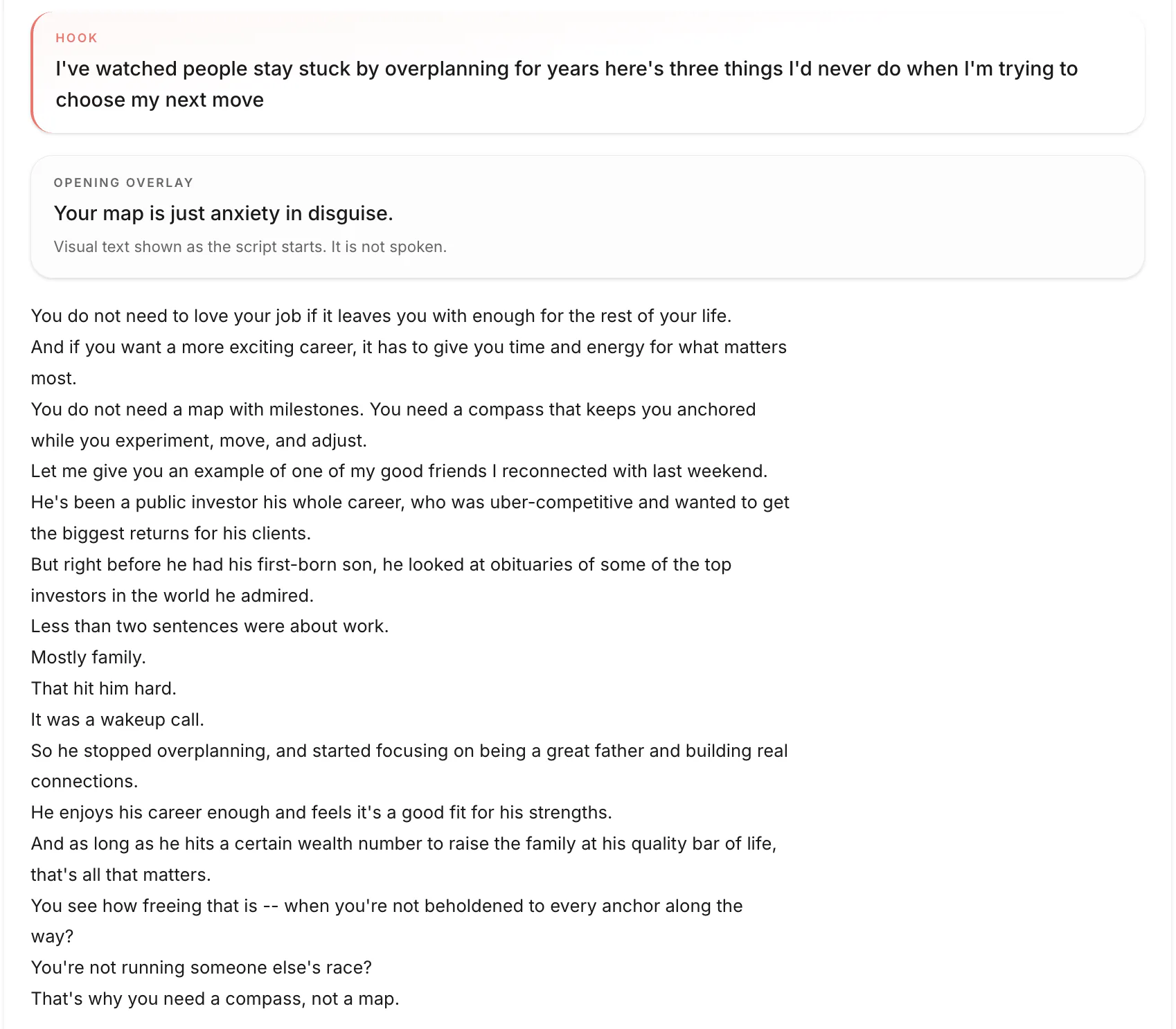
Melda script generation screen showing a ready-to-record short-form script

Worked example

One podcast moment, worked into one script.

Stay with one actionable point instead of summarizing the whole episode. This example takes a single beat from a public interview and shapes it into a short script.

Editorial example based on a public episode. The hook and script below were written for this guide.

The source moment

“every time you reach for a door handle just pause”
Jim Kwik, guest on The Jefferson Fisher Podcast, “Brain Expert: How to Think Faster in Difficult Conversations.” Watch from 3:23 ↗

Selected idea

Practice a pause using an everyday cue

Why this moment stands alone

It is one complete instruction: a cue, a small action and a reason to repeat it. A viewer who never hears the rest of the conversation can still understand it and try it.

The script

Writer's angle

Practice a pause before a conversation gets difficult: pick one routine cue and rehearse the pause there, instead of summarizing everything else the episode covers.

Hook

Practice your pause before a conversation gets difficult.

Full script

Practice your pause before a conversation gets difficult. On The Jefferson Fisher Podcast, Jim Kwik describes a small mental exercise: pause each time you reach for a door handle. He pairs it with a second cue, pausing whenever your phone rings, and says you get better at it the more you repeat it. So don't wait for a tense moment to try pausing for the first time. Pick one cue you meet every day. Pause there, every time, this week. That way you have practiced the pause before a conversation gets difficult.

Review note: credit the guest and the show by name and link the episode. The door-handle and phone cues come from Jim Kwik; applying them before a difficult conversation is the writer's framing, so the script does not present it as his claim or promise a result.

Moment types

The best Shorts usually come from one self-contained beat.

A good episode may contain many beats, but each short-form script should commit to one.

A contrarian line the guest or host can defend
A story pivot where the lesson becomes clear
A framework that makes a messy topic simple
A quote that already sounds like a title
A tactical list that can stand alone

Podcast path

Keep the episode context, then shape the short-form script.

Melda helps podcast creators and teams extract the moments worth scripting without turning the whole episode into generic social copy.

FAQ

Questions creators actually ask

Straight answers to the questions creators ask before they start.

How do you repurpose a podcast into Shorts?

Start with the full episode or transcript, break the conversation into self-contained moments, choose the strongest moment, match a hook to that moment, and generate a short-form script that can work across YouTube Shorts, TikTok, and Reels.

What moments from a podcast make good Shorts?

Good podcast Shorts often come from a contrarian line, a story pivot, a framework that simplifies a messy topic, a quote that already sounds like a title, or a tactical list that can stand alone without the full episode.

Can one podcast episode become multiple short-form scripts?

Yes, when the episode contains multiple distinct moments. Each script should focus on one moment with its own hook, proof, and payoff instead of compressing the full episode into one generic summary.

How is this different from clipping software?

Clipping software helps find and package existing video moments. A script-first workflow helps choose the idea, shape the hook, and write a recordable short-form script, which is useful when the team wants new creator-led content from the episode source.

Ready to try it on your own material?

About 3 scripts free · no card required